
If you’re selling on Amazon.co.uk, your fastest path to clarity is running your top SKUs through the FBA Revenue Calculator before you touch pricing or packaging.
The headline numbers to know: the Professional plan runs £25 excluding VAT per month, the Individual plan charges £0.75 per unit sold, and referral fees typically sit between 8% and 15% of the total sale price depending on category. Layer on fulfilment fees by size tier, storage charges by cubic foot, and the new surcharge, and a SKU that looked profitable in January can quietly lose money by autumn.
Before you read another word, do three things:
- Run your best-selling SKUs through the FBA Revenue/Fees Calculator.
- Re-measure and re-weigh your top products, packaging included.
- Check how long your current stock has been sitting in an Amazon fulfilment centre.
Key Takeaways
Cutting FBA fees in the UK comes down to modelling every fee layer per SKU, reacting fast to the 2026 surcharge and Low-Price FBA changes, and catching aged inventory before it triggers surcharges.
| Point | Details |
|---|---|
| Model fees by fee type | Track selling plan, referral fee, fulfilment fee, storage, and the 1.5% surcharge separately per SKU. |
| Re-check packaging regularly | Right-sizing boxes can drop a product a full fulfilment size tier and save over a pound per unit. |
| Watch the 241-day threshold | Aged inventory surcharges apply after 241 days in storage and rise again past 365 days. |
| Verify with the right tool | Use the Revenue Calculator to plan, Fee Preview to check live stock, and Profit Analytics for actuals. |
| Automate the audit | Osellpa connects to Amazon’s API to surface SKU-level profit and fee leakage without manual spreadsheets. |
Table of Contents
- What are the main FBA fees UK sellers need to model?
- What changed with Amazon FBA fees in the UK for 2026?
- How do you calculate FBA fees for a specific SKU?
- Which hidden charges catch UK sellers out?
- How can UK sellers cut FBA fees without hurting sales?
- How does automated analytics stop FBA fee leakage?
- What would you prioritise on a mid-size UK account right now?
- Put your FBA fee audit on autopilot
- Frequently asked questions
- Sources
What are the main FBA fees UK sellers need to model?
Every FBA fee falls into one of four buckets, and each one behaves differently depending on your product, your pricing, and how long stock sits on the shelf.
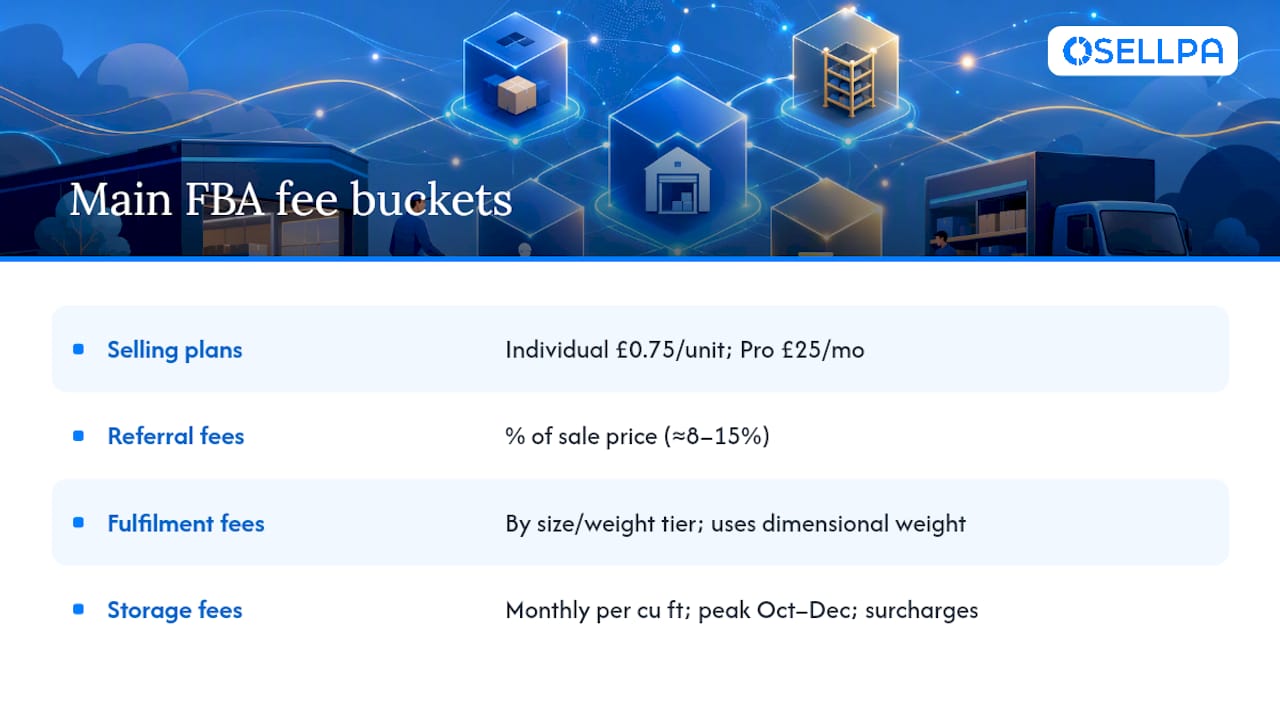
Selling plans set your baseline cost of trading. The Individual plan costs £0.75 per unit sold, with no monthly fee, making sense if you’re shifting under roughly 35 units a month. The Professional plan costs £25 excluding VAT per month regardless of volume, and it unlocks bulk listing tools, advertising, and Buy Box eligibility. Most sellers who plan to scale past a handful of sales choose Professional from day one.
Referral fees are Amazon’s cut of each sale, charged as a percentage of the total sale price rather than just the item cost. Rates vary by category, and most categories fall between roughly 8% and 15%, though a handful of categories carry different structures and minimum referral fees that kick in on very low-priced items. This is where sellers often underestimate their true margin, because the fee applies to the full price the customer pays, including any part of your listed price that covers shipping.
Fulfilment fees cover the pick, pack, and ship work Amazon does on your behalf, and they scale with size and weight tier rather than price. A small envelope-sized item sits in a much cheaper tier than a bulky standard parcel, and Amazon calculates the fee using dimensional weight, meaning a light but bulky product can cost more to fulfil than a heavy, compact one. Published UK rate cards show base fulfilment fees rising in clear steps across envelope, parcel, and oversize tiers, and Low-Price FBA can shave roughly £0.24 to £0.40 off the base fulfilment fee in some of those tiers.
Storage fees are billed monthly based on your daily average inventory volume in cubic feet, with rates that rise during the October to December peak season. On top of that, aged inventory surcharges apply once stock has been held beyond certain storage duration thresholds, increasing with longer storage periods — a cost that catches out sellers who overstock ahead of a launch that underperforms.
Here’s a worked example for a mid-weight standard parcel SKU selling at £18:
What changed with Amazon FBA fees in the UK for 2026?
Two changes matter more than anything else this year, and both need to go straight into your spreadsheet.
- 17 April 2026: Amazon introduced a 1.5% fuel and logistics-related surcharge applied to FBA fulfilment fees across the UK and several European marketplaces.
- Low-Price FBA expansion: eligibility widened so that many products priced at or below £20 including VAT qualify for reduced fulfilment fees, with some categories using a lower £10 threshold instead.
The surcharge sounds small, but it compounds. It’s calculated as a percentage of the fulfilment fee, not the sale price, so a £4.50 fulfilment fee picks up an extra £0.0675, rounded in Amazon’s systems. Multiply that across thousands of monthly units and it becomes a real line item, particularly for sellers moving high volumes of low-margin stock.
The most common misunderstanding is treating the surcharge as a flat add-on to the final invoice rather than a fee that recalculates every time your fulfilment tier or dimensional weight changes. Sellers who packaged more efficiently after reading this fee structure often find their surcharge shrinks alongside their base fulfilment fee, not just their referral fee.

That way, if you switch a SKU into a smaller size tier or Low-Price FBA, the surcharge recalculates automatically, and you can see the true saving in one glance.*
How do you calculate FBA fees for a specific SKU?
Building a reliable per-SKU cost model takes a handful of consistent inputs, tracked the same way for every product you list.
- Record your sale price and your landed cost, including freight and duty, separately from any VAT you’ll remit.
- Apply the correct referral fee percentage for that specific category, checking for a minimum referral fee if the item is low-priced.
- Confirm the size and weight tier from Amazon’s published fulfilment fee table, using the dimensional weight if it exceeds actual weight.
- Apply the 1.5% surcharge to the fulfilment fee line.
- Prorate your monthly storage cost using daily average volume in cubic feet, divided by expected monthly unit sales.
- Add an allowance for returns processing and occasional removals.
Track these columns in your spreadsheet: SKU, sale price, landed cost, referral fee %, fulfilment tier, fulfilment fee, storage volume (cubic feet), average days in storage, and net margin per unit.
For verification, three Amazon tools each do a different job. The FBA Revenue Calculator projects fees before you list a product or change its packaging. The Fee Preview report shows estimated fees for your current live inventory, drawing on real listing data. Profit Analytics dashboards then show what actually happened after the sale. Use the Revenue Calculator for planning, Fee Preview for a health check on existing stock, and Profit Analytics for the ground truth.
Worth remembering: Fee Preview figures can be up to 72 hours old, so treat it as a strong estimate rather than the final invoice, especially in the days right after a fee change takes effect.
How can UK sellers cut FBA fees without hurting sales?
Fee reduction works best when you tackle the highest-impact, lowest-effort changes first, then move on to strategic decisions that take longer to pay off.
- Right-size your packaging. Switching from an oversized box to snug packaging can drop a product a full size tier, often saving more than a pound per unit in fulfilment fees alone.
- Check Low-Price FBA eligibility on every SKU under £20. If your product qualifies, the reduced fulfilment fee can save roughly £0.24 to £0.40 per unit, which adds up fast across high-volume, low-margin lines.
- Time your inventory to dodge peak-season storage rates. Sending in stock just after the October to December surcharge window, rather than during it, can meaningfully cut your monthly storage bill.
- Manage inventory age actively. Set alerts at 150 and 200 days in storage so you can discount or remove stock before it crosses the 241-day aged inventory threshold.
- Use Remote Fulfilment or Pan-EU strategically for cross-border orders, comparing the fee difference in the Revenue Calculator rather than assuming one method is always cheaper.
Here’s a concrete example: a seller shipping a small kitchen gadget at £16.99 discovers their packaging pushes it into the standard parcel tier at £3.80 in fulfilment fees. Trimming the outer box by two centimetres drops it into the light parcel tier at £2.95, and the same product also qualifies for Low-Price FBA, taking a further £0.30 off. Combined, that’s roughly £1.15 saved per unit, which on 2,000 monthly units is over £2,000 a month back in margin.
Beyond packaging and pricing tiers, Amazon runs launch incentives worth folding into your cost planning. The New Brand Bonus programme offers credits toward Sponsored Ads and FBA shipping for eligible new brands, which can offset the early fee burden while you’re still finding product market fit. Pair that with automated repricing so you’re not manually adjusting prices against shifting fee tiers, and consider bundling slow-moving, low-margin SKUs together rather than letting them sit and accrue storage charges individually.
If you’re managing shipments and fulfilment routing across borders, it’s worth reviewing how UK sales order automation tools interact with fulfilment choices before you commit stock to Remote Fulfilment or Pan-EU.
Pro Tip: Run a quarterly “size tier audit” across your top 20 SKUs by volume. Fulfilment tiers and Low-Price FBA thresholds shift as Amazon updates rate cards, so a product that missed eligibility in January might qualify by summer.
How does automated analytics stop FBA fee leakage?
Fee leakage tends to show up in a handful of predictable places:
- Dimensions entered once at listing creation and never re-checked after a packaging change.
- Reimbursements owed for lost or damaged warehouse stock that never get claimed.
- Returns processing fees applied inconsistently across near-identical SKUs.
- Inventory quietly crossing the 241-day aged threshold without anyone noticing.
Osellpa connects directly to your Amazon data through the API, automating fee audits and showing profit by SKU without manual spreadsheet reconciliation, so discrepancies between expected and actual fees surface immediately rather than at your next quarterly review.
Pro Tip: Use SKU-level profit alerts to flag stock approaching the 241-day aged inventory mark, so you can run a promotion or removal before the surcharge erodes what’s left of your margin.

What would you prioritise on a mid-size UK account right now?
I’d re-measure every top-20 SKU this week, run Fee Preview across the whole catalogue, and check Low-Price FBA eligibility before chasing more sales volume. Growth without margin discipline just scales your losses.
Put your FBA fee audit on autopilot
Osellpa connects to your Amazon account and automates that entire fee audit, showing profit by SKU, flagging inventory approaching aged storage thresholds, and running PPC optimisation alongside your margin data, so fee leakage gets caught before it compounds.
This article is published by Osellpa, and the recommendations reflect our own product’s capabilities alongside Amazon’s official fee structures. If you want to see your own FBA fees mapped against real profit, start with a look at Osellpa’s dashboard and run your top SKUs through it directly.
Frequently asked questions
How much are FBA fees in the UK in 2026?
It’s a fuel and logistics-related charge applied to FBA fulfilment fees from 17 April 2026 across the UK and several European marketplaces, calculated as a percentage of your fulfilment fee rather than your sale price.
Does Low-Price FBA apply to all products under £20? Most categories qualify at the £20 including VAT threshold, though some categories use a lower £10 threshold instead, so check eligibility per SKU using the Low-Price FBA rates page.
How do I avoid FBA long-term storage fees? Monitor how long each SKU has sat in a fulfilment centre and act before the 241-day mark, either through a promotion, a bundle, or a removal order, since surcharges increase again past 365 days.
What’s the difference between FBA and FBM costs for UK sellers? FBA bundles fulfilment, storage, and customer service into Amazon’s fee structure, while FBM (Fulfilment by Merchant) shifts those costs to your own logistics setup, which can be cheaper for bulky, slow-moving stock but usually loses the Prime badge that drives conversion.


