
The best portfolio structure for Amazon Ads is one that mirrors how you make money. Group campaigns by product line and by the job each product does (launch, grow, defend), give each group a budget that reflects its margin, and name everything so you can filter it later. Done well, you can look at one portfolio and know what it spent, what it sold and whether it paid for itself.
That last part is where most accounts fail. Amazon shows you ACoS (advertising cost of sales: ad spend divided by ad-attributed sales) by campaign, but it knows nothing about your fees, your cost of goods or your VAT. Osellpa’s profit tracking and PPC tools are built around Amazon’s API data so that structure and profit sit in the same place. This guide shows you how to build the structure first.
TL;DR
- A portfolio groups campaigns, a campaign holds ad groups, and an ad group holds your keywords, targets and advertised products. Build from the top down: portfolio, then campaign, then ad group.
- Make each portfolio answer one business question, such as “how is this product line performing?” or “what is our launch spend?”, rather than mirroring Amazon’s menus.
- Separate campaigns by product group, intent and targeting type, and use a consistent naming pattern so reports filter cleanly.
- Set budgets by margin and role, and judge each portfolio on profit after advertising, not ACoS alone. Work on ex-VAT figures.
- Review weekly at portfolio level, and move proven search terms from automatic into manual campaigns.
Table of Contents
- How portfolios, campaigns and ad groups fit together
- Start with product roles, not Amazon menus
- Three portfolio structures that work
- Build the campaigns inside each portfolio
- Name everything so you can filter it later
- Set budgets from margin, not from habit
- Judge each portfolio on profit, not ACoS alone
- Run a weekly portfolio review
- Common structure mistakes
- Where Osellpa fits
- Our perspective
- FAQ
- Sources
How portfolios, campaigns and ad groups fit together
Amazon Ads has three layers, and each one controls different things.
Portfolio. A label that groups campaigns so you can see their combined results and, if you wish, cap their combined spend. Amazon’s own UK guide suggests sellers with several product categories start creating portfolios to organise campaigns by brand, category, season or any way they choose. That freedom is the problem: Amazon does not tell you which grouping is useful.
Campaign. This is where the daily budget, bidding strategy, placement adjustments and dates live. Everything set at campaign level applies to every ad group inside it. If two products need different budgets, they need different campaigns.
Ad group. This holds the advertised products and the targeting: keywords, negative keywords and product targets. Keep ad groups tight, with products that share a customer and a price point, so one bid is reasonable for all of them.
The practical rule: put a decision at the level where it is controlled. Budget decisions belong to campaigns and portfolios. Bid decisions belong to keywords and targets. Profit decisions belong to the product, which is why your structure should lead with the product.
Three portfolio structures that work
By product line
One portfolio per product line or brand: “Kitchen knives”, “Chopping boards”, “Aprons”. This is the right default for most private-label sellers, because each line has its own cost base and margin. You can read a portfolio and see whether that line pays.
By role
One portfolio per role: “Heroes”, “Core”, “Launches”, “Brand defence”. This suits larger catalogues where the same budget logic applies to dozens of products. Its weakness is that it hides product-line economics, so pair it with product group in your campaign names.
Hybrid
Product line portfolios, with role in the campaign name. This is the version we would recommend to most growing sellers, because the portfolio answers “how is this line doing?” and a filter answers “how are my launches doing across all lines?”.
Whichever you choose, avoid a portfolio structure that mirrors the ad type (one for Sponsored Products, one for Sponsored Brands). Ad type tells you nothing about profit.
Build the campaigns inside each portfolio
Each campaign should be built around one product group, one intent and one targeting type. That way a campaign’s numbers mean something: if it loses money, you know why.
A clean set for one product group usually looks like this:
- Automatic campaign. Amazon chooses where the ad appears. Its job is discovery: it shows you which search terms and products convert.
- Exact-match keyword campaign. Your proven terms, with the highest budget and tightest bids.
- Phrase or broad campaign. Wider coverage for variations, with a smaller budget.
- Product targeting campaign. Ads on specific competitor or complementary listings, kept separate because its economics differ from keyword campaigns.
- Brand defence campaign. Your brand name, kept in its own campaign so cheap, high-converting brand clicks do not flatter the rest of your results.
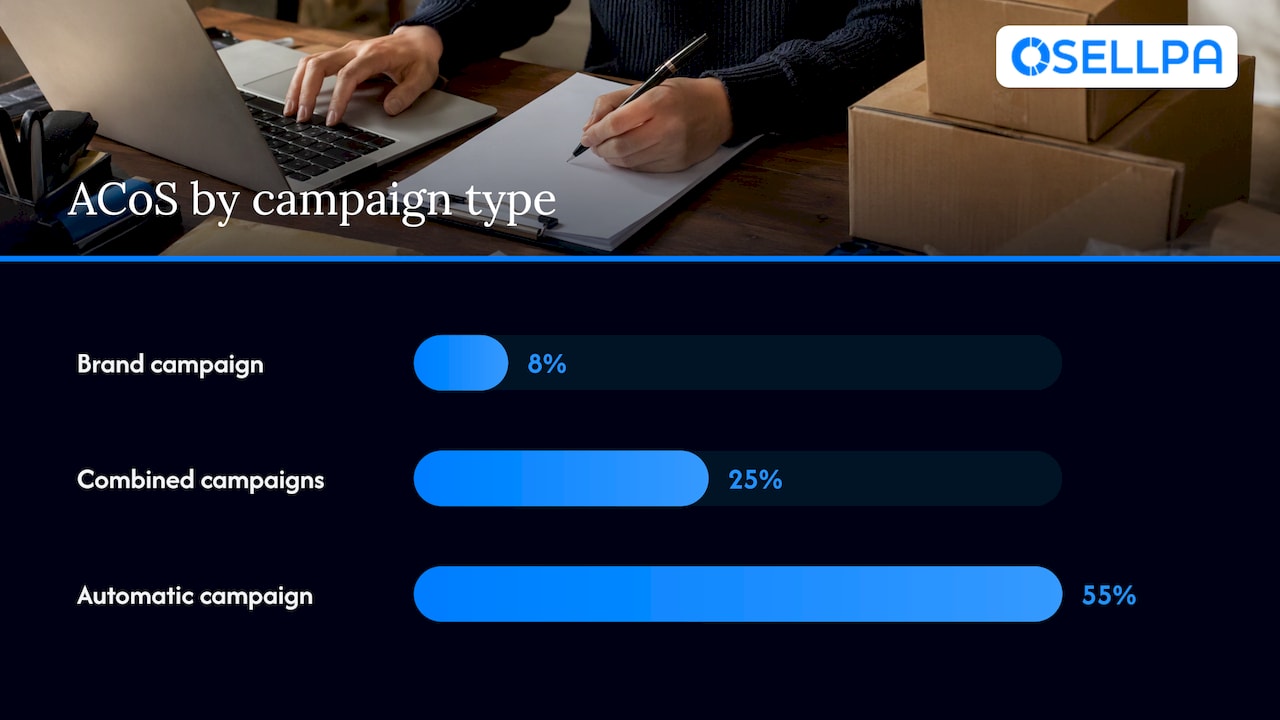
Separating these matters because blending them produces misleading averages. A brand campaign might run at 8% ACoS and an automatic campaign at 55%. Together they look like a healthy 25%, and you will never see which one needs attention.
Amazon’s UK success tips advise running campaigns always on, with no end date, and using the search term report to move top-performing keywords into manual campaigns. That is the engine of the structure: automatic campaigns discover, exact campaigns profit from what was discovered.
Negatives belong in the structure too
As you promote a search term into an exact campaign, add it as a negative in the automatic campaign so the two do not compete for the same click. Add clearly irrelevant terms as negatives as you find them. Our guide to lowering ACoS by starting with negatives walks through the order of work.
Name everything so you can filter it later
Names are how you will analyse an account of 50 or 500 campaigns. Use a fixed pattern with the same tokens in the same order. For example:
SP_HERO_KNIVES-CHEF_CAT_EXACT_2611
Read left to right: ad type, product role, product group, intent (brand, category or competitor), targeting type, and start month. Because each token is separated, you can filter a spreadsheet export for every exact-match campaign, or every launch campaign, in seconds.
Three habits keep names useful:
- Agree the tokens once and never improvise. “Chef knives” and “chef-knives” become two groups in a filter.
- Keep the portfolio name short and human: the product line, not a code.
- Put the start month in the name so you can compare campaigns by vintage.
Set budgets from margin, not from habit
Budgets work on two levels. Each campaign has a daily budget. A portfolio can additionally carry a budget cap over a chosen period, which gives you a ceiling for a whole product line. Our UK guide to portfolio budgets covers how the caps interact with campaign budgets in detail.
A sensible order of work:
- Decide the total monthly ad spend you can afford, as a share of expected revenue.
- Split it by role and margin. Heroes and high-margin core products should take the largest share. Launches get a fixed allowance for a fixed period.
- Split each share by product group, then by campaign, weighting exact-match campaigns most heavily.
- Set portfolio caps slightly above the intended monthly spend, so a strong day is not throttled but a runaway campaign is contained.
Amazon’s UK best-practice guide suggests starting a Sponsored Products daily budget at no less than £10. If you are lean, our piece on a £10 daily PPC budget explains how to treat early spend as data rather than as a verdict.
Also remember that daily budgets are spent as fast as traffic arrives rather than paced across the day. A budget that is too small means your ad disappears by mid-morning, which is the most common reason a sound campaign underperforms.
Judge each portfolio on profit, not ACoS alone
This is where structure pays off. ACoS tells you how much you spent for each pound of sales. It does not tell you whether the sale was profitable. For that you need your break-even ACoS: the ACoS at which you make exactly nothing after advertising.
The calculation is the margin before advertising divided by the ex-VAT selling price. UK sellers need to be careful here, because ad-attributed sales do not include VAT, so your costs and price must be on the same VAT-free basis.
An illustrative example:
| Item | Amount |
|---|---|
| Selling price including VAT | £30.00 |
| Selling price excluding VAT (÷ 1.2) | £25.00 |
| Amazon referral fee, FBA fee, product cost and other costs (ex-VAT) | £14.00 |
| Margin before advertising | £11.00 |
| Break-even ACoS (£11 ÷ £25) | 44% |
At 44% ACoS this product breaks even on ad-driven sales. A target well below that, say 60–80% of break-even, is what protects profit. Our guides on setting target ACoS at 60–80% of break-even and on calculating UK break-even ACoS go through the maths with UK fee examples.
Once you have break-even per product, each portfolio gets its own target. A hero line at 32% margin can sustain a higher target than a thin-margin tail line. A launch portfolio gets a deliberately higher ceiling, but with an end date written into your plan. For the product-level numbers that feed all this, see how to work out what each SKU really earns.
Run a weekly portfolio review
Structure only helps if you look at it on a rhythm. Once a week:
- Check spend against cap. Has any portfolio spent most of its budget early in the month? If so, either the cap is too low or one campaign is absorbing everything.
- Compare each portfolio’s ACoS with its own target, not with a single account-wide number.
- Harvest search terms. Move converting terms from automatic campaigns into exact campaigns and add them as negatives in the source campaign.
- Add negatives for clicks that spent without selling.
- Review launches against their agreed window. Either promote, extend with a reason, or reduce.
Allow time for attribution before you judge a change. Sales can be credited to an ad days after the click, so reacting to yesterday’s numbers often means reacting to incomplete data. Our guide to auditing ads weekly and waiting 7 to 14 days explains the pattern.
Common structure mistakes
- Too many products in one campaign. One strong seller takes the budget and the rest never get impressions.
- Portfolios with no purpose. If you cannot say what question a portfolio answers, merge it.
- Mixed match types in one campaign. You lose the ability to tell which type earns its keep.
- Brand and non-brand together. Brand clicks flatter the average.
- Caps set at exactly the intended spend. A good day then stops your ads early. Leave a small margin.
- Inconsistent names. The cost shows up months later, when you cannot filter your data.
- Judging launches by mature-product targets. This kills new products before they gather data.
Where Osellpa fits
A well-built structure is only useful if you can see profit through it. Osellpa connects to Amazon’s API and combines profit and loss reporting with PPC optimisation, automatic and manual, so your ad structure and your profit figures live in one tool instead of several spreadsheets. If you want a quick look at where your bids stand, there is a free PPC bid optimisation report.
Plans are subscription-based and tiered by Amazon sales volume. Launch is £10 per month (£96 per year), Scale is £20 per month (£192 per year) and Advanced is £40 per month (£384 per year). Details are on the pricing page.
Our perspective
Most sellers we talk to about portfolios start by asking how many to create. We think the better question is what decision each one supports.
A portfolio is a lens. If it lines up with a product line, a role and a margin, you can see at a glance where money is made and where it leaks. If it lines up with nothing, it is a folder.
That is why we built Osellpa around accurate profit tracking and automated PPC management that connects directly to Amazon’s API. Sellers should not need a tangle of spreadsheets to know whether a campaign pays. The structure sets the questions, and the data should answer them without manual work.
Whether you are new and overwhelmed by reports, selling part-time and need to trust your profit figure, or running a large catalogue where automation is the only way to keep up, the principle is the same: structure by how you earn, then measure by what you keep.
Harry
FAQ
How many portfolios should I have?
One per product line or brand is a good starting point, plus a launch portfolio if you introduce products regularly. Most small sellers need between two and six. If you cannot describe what a portfolio tells you, it is probably unnecessary.
Does a portfolio budget replace campaign budgets?
No. Each campaign keeps its own daily budget, and the portfolio cap adds a ceiling for the group. Set the cap a little above your intended monthly spend so a busy day is not throttled, then review pacing weekly.
Should I put Sponsored Products and Sponsored Brands in the same portfolio?
Yes, if they promote the same product line. Portfolios exist to group by business logic, not by ad type, so keeping them together lets you see the full cost and return of advertising that line.
When should I move a keyword from an automatic to an exact campaign?
When the search term report shows it converting at an acceptable ACoS for your product. Add it to the exact campaign, then add it as a negative in the automatic campaign so the two do not compete for the same click.
How do I know my structure is working?
You should be able to open any portfolio and state its spend, its sales, its ACoS against its own target and its profit after advertising. If you cannot, simplify names, merge portfolios or separate campaigns that blend different intents.