
Amazon does not calculate its star rating with a simple average. It runs a machine-learned model that weights recency, verified-purchase status, and authenticity signals, so two products with identical scores can carry very different star displays. The most useful benchmarks for judging review rate are the ratio of reviews to units sold and the proportion carrying the Verified Purchase badge. Monitoring both, rather than a single headline number, tells you whether a rating reflects genuine current demand.
TL;DR:
- Most Amazon reviews come from verified purchases and detailed feedback, which are weighted more heavily in the star rating calculation.
- Review rates vary by product type, with cheap items often below 1% and higher-priced or niche products typically exceeding 1%.
- A high volume of reviews in a short period, especially on old listings, signals potential review manipulation or fake reviews.
- Monitoring recent review rate, verified purchase ratio, and core rating trends provides better insight into product quality than the star rating alone.
- Genuine reviews with specific details and off-platform mentions help identify authentic customer feedback versus fake or manipulated reviews.
Table of Contents
- How Amazon calculates star ratings
- What counts as a healthy review rate?
- Does a higher star rating actually improve sales?
- How to spot a suspicious or inflated review profile
- How reviews get submitted and what the badges mean
- Metrics sellers should actually be tracking
- Two checklists worth keeping on hand
- Turning review-rate data into a growth lever
- Where these figures and claims come from
- Sources
How Amazon calculates star ratings
If you assumed a product with many five-star reviews and some one-star reviews would average around 4.1, you would be applying arithmetic that Amazon does not use. Amazon uses machine-learned models rather than a plain average, and those models weigh several signals before settling on the number you see next to the buy box.
The company’s own explanation of how customer reviews and star ratings work confirms the model leans on:
- Recency — a review from last month carries more weight than one from three years ago, because it better reflects the product as it currently ships.
- Verified Purchase status — reviews tied to an actual Amazon order are trusted more heavily than unverified ones.
- Review text richness — detailed, specific reviews with context tend to be weighted differently than a bare star click.
- Authenticity flags — suspected manipulation, review-swap rings, or incentivised posting patterns get down-weighted or excluded.
This is why a rating can shift by a tenth of a point overnight even when only two or three reviews arrive. The model is constantly re-scoring the whole review set against fresh recency and trust data, not just appending a new number to a running total. Amazon has also said it stops hundreds of millions of suspected fake reviews before shoppers ever see them, which gives some sense of how much filtering happens behind that single displayed figure.
What counts as a healthy review rate?
Review rate is the share of buyers who leave a review, usually expressed as reviews per hundred units sold. It is the metric that tells you whether a rating is built on a broad base of opinion or a thin, easily skewed one.
There is no single fixed figure because category, price point, and buyer type all move the number:
- Low-consideration, cheap items (phone cases, kitchen gadgets under £15) often see review rates below 1%, simply because buyers rarely bother reviewing a low-stakes purchase.
- Higher-ticket or niche products (supplements, tools, baby gear) tend to run higher, sometimes into the low single digits, because buyers who researched carefully are more invested in sharing an opinion.
- New listings naturally show a lower rate early on, since review volume lags unit sales by weeks.
A product with thousands of units sold and only a handful of reviews is not necessarily suspicious, but it is thin, and a single cluster of negative feedback can swing its displayed score disproportionately. A product with a low single-digit percentage review rate and a steady drip of Verified Purchase reviews over months, rather than a burst in one week, is the pattern worth trusting.
Does a higher star rating actually improve sales?
Reviews do more than reassure a browsing shopper. Star rating and review count sit close to price on the list of factors that decide whether a click turns into a purchase, and the effect compounds with volume: a product with 500 reviews at 4.5 stars reads as safer than an identical one with twelve reviews at the same score, even though the star figure is unchanged.
That conversion lift has knock-on effects sellers often miss:
- Advertising efficiency improves indirectly. Higher organic conversion tends to lower effective cost-per-click on the same keyword, because Amazon’s ad auction favours listings that convert well.
- Off-Amazon trust signals matter too. Reviews from Amazon can be displayed on a merchant’s own site through Buy with Prime, extending the same social proof beyond the marketplace.
- Campaign performance data becomes easier to read once review-rate changes are tracked against sales, rather than assumed.
Pro Tip: Track a rolling four-week cohort of your most recent reviews separately from your lifetime average. A dip in the recent cohort often shows up in conversion rate two to three weeks before it drags down the overall star score, giving you an early warning most sellers miss.
Testing this properly means comparing conversion rate in windows before and after a meaningful review-rate change, rather than eyeballing the star number in isolation.
How to spot a suspicious or inflated review profile
Checking a listing’s credibility takes less time than reading a single long review, if you know where to look.
- Look for velocity spikes. A sudden cluster of twenty reviews in three days, especially on a listing that previously got one a week, is the clearest single red flag.
- Check the Verified Purchase ratio. A healthy listing usually shows the large majority of reviews as verified; a high share of unverified five-star reviews is worth treating with suspicion.
- Read for specificity. Genuine reviews mention how the product performed in a real situation. Vague praise repeated across multiple reviews in similar phrasing suggests coordinated posting.
- Cross-reference off-platform. A quick search on Reddit or YouTube for the product name often surfaces independent opinions that either support or contradict the Amazon picture.
- Run a third-party checker as a second opinion, not a verdict. Tools built to check for fake Amazon reviews are useful but limited, since they can only read signals Amazon exposes publicly.
How reviews get submitted and what the badges mean
Not everyone who buys a product can review it freely, and not every review counts toward the visible star rating in the same way. Amazon’s own guidance on understanding customer reviews and ratings sets the eligibility rules: reviewers need an account with a qualifying purchase history, and reviews lacking Verified Purchase status are excluded from the overall rating unless they include text, images, or video.
A useful review generally includes:
- A star rating that matches the tone of the written comment.
- A short, specific headline describing the actual experience.
- Context: how, when, and for what purpose the product was used.
- A photo or short video where relevant, since these carry more weight in the model.
The “Customers say” highlights you see near the top of a listing are AI-generated summaries pulled from common themes across the review text, a feature Amazon built specifically to help shoppers skim large review sets quickly.
Metrics sellers should actually be tracking
Watching your overall star rating tells you almost nothing about direction. Watching review rate, Verified Purchase ratio, and a rolling recent-average score together tells you whether things are improving or slipping, and how fast.
- Review rate by week, not by lifetime total, to catch changes as they happen.
- Verified-purchase ratio, since a sudden drop often precedes a manipulation flag from Amazon itself.
- Rolling recent-average rating, isolated from the lifetime figure, to spot quality drift early.
Requesting reviews within Amazon’s rules, rather than through incentives or off-platform swaps, is the only sustainable route, and tools like Osellpa’s automated review requester can handle the timing and messaging without risking a policy breach.
Pro Tip: Pair review-rate tracking with your Brand Analytics keyword data — a rise in branded search volume often shows up a week or two after a genuine review-rate improvement, which is a cleaner signal than watching the star number alone.
Two checklists worth keeping on hand
Shoppers checking a listing should look for the Verified badge, a healthy spread of recent reviews, specific real-world detail, and mentions of the product outside Amazon. Sellers should track review-rate cohorts weekly, stick to policy-safe request methods, and measure the actual conversion shift rather than assuming one. The ethical line matters here: a rating built on genuine buyer experience compounds in value over years; one built on manipulation gets flagged eventually, and the fall is steeper than the climb ever was.
— Harry
Turning review-rate data into a growth lever
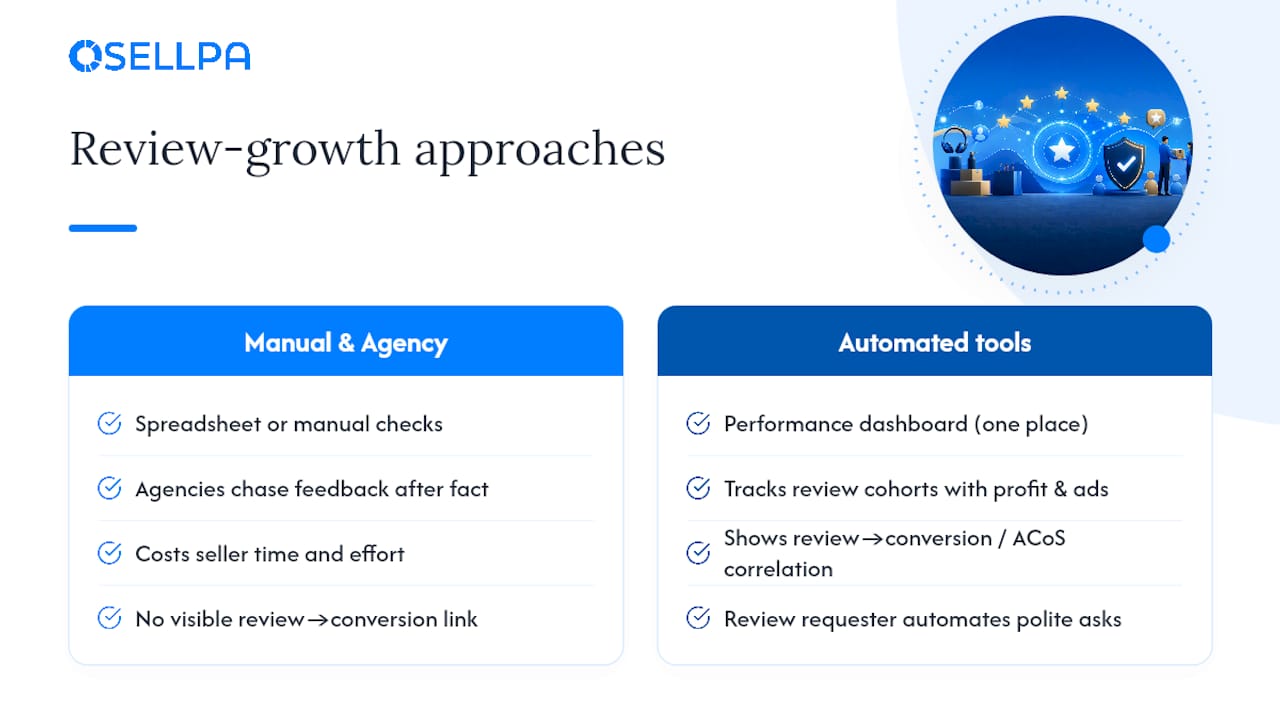
There are other ways to chase review growth. Some sellers rely on spreadsheets and manual checks, others hire agencies to chase feedback after the fact. Both routes cost time you could spend elsewhere, and neither shows you the connection between a review-rate change and what it actually did to your conversion rate or ad spend.
There are alternatives to spreadsheet-based tracking for sellers who want that connection made visible automatically. The performance dashboard tracks review-rate cohorts alongside profit and advertising data in one place, so a shift in verified reviews shows up next to the sales and ACoS movement it actually caused, not three separate tabs you have to line up yourself. The review requester automates policy-safe requests on the right timing window, and sellers pairing that with the PPC optimisation reports get a clearer read on whether a review-rate improvement is genuinely lowering their cost per click. If you sell on Amazon and want to see that correlation for your own catalogue, start with a free PPC bid optimisation report and check what your own numbers are actually telling you.
Where these figures and claims come from
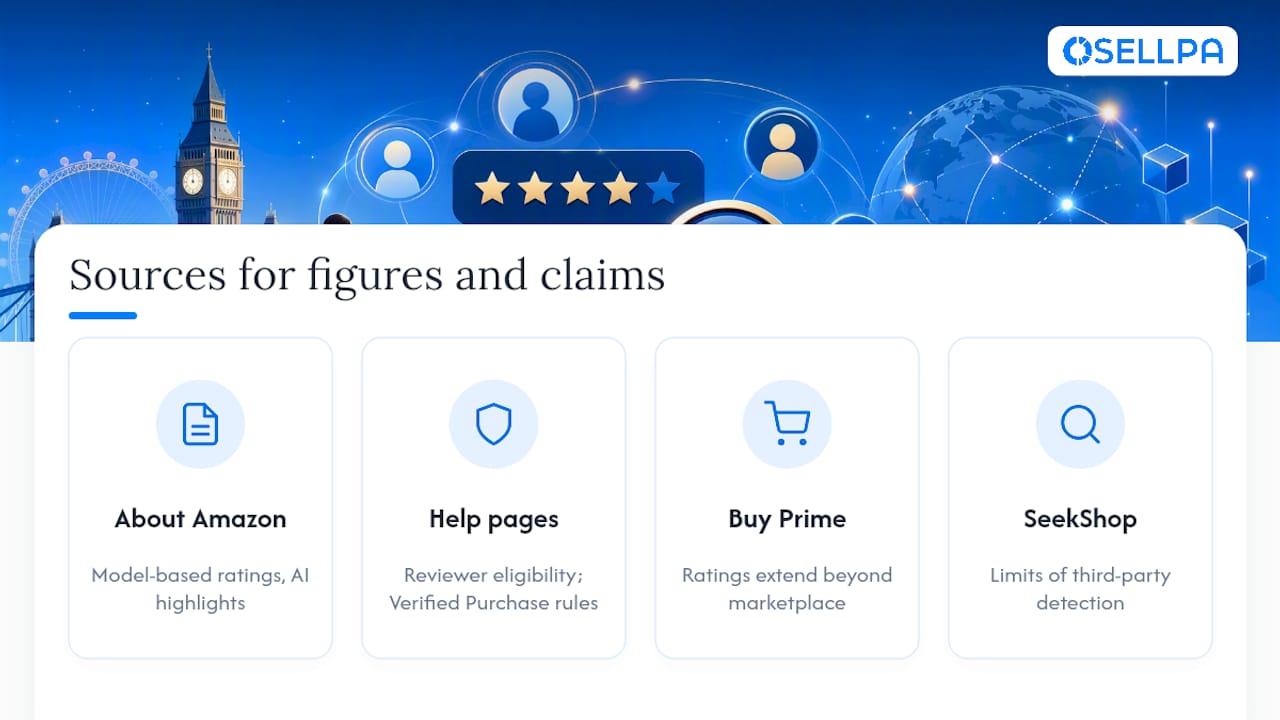
The mechanics of Amazon’s rating system described here come directly from About Amazon’s explainer on how customer reviews and star ratings work, which covers the model-based approach and the AI-generated review highlights. Amazon’s own help pages on customer reviews and ratings set out reviewer eligibility and Verified Purchase rules in full. The Buy with Prime documentation on Reviews from Amazon explains how ratings extend beyond the marketplace itself, and SeekShop’s guide to spotting fake Amazon reviews covers the limits of third-party detection tools.


