
Run phrase match first to discover which searches convert, then move the winners into exact match campaigns for tighter bid control. Phrase catches modifiers and variations you haven’t thought of; exact narrows targeting to proven queries and clarifies which keyword actually earns the sale. Test keywords for a sufficient period before promoting profitable search terms from phrase into exact.
TL;DR:
- Amazon’s exact match includes plurals and close variants, making it more flexible than a literal interpretation, which impacts campaign targeting and optimization.
- Running phrase match campaigns first allows for broad discovery, and only the profitable search terms should be promoted into exact match campaigns to improve bid precision and control.
- Testing keywords for at least one to two weeks is recommended before promoting or pausing, ensuring sufficient data for accurate decision-making.
- Setting higher bids on exact match keywords reflects their proven performance, while lower bids on phrase match help maintain discovery without overspending.
- Automating the promotion of high-performing phrase keywords to exact match through tools like Osellpa can increase sales by up to 20% by reducing manual review delays.
Table of Contents
- Exact vs phrase Amazon: how each match type actually behaves
- Building a phrase to exact match campaign workflow
- How should you set bids across match types?
- What metrics actually show which match type is working?
- Common mistakes sellers make with phrase and exact match
- What running these campaigns week to week actually looks like
- Get Osellpa to run the phrase to exact workflow for you
- Sources
- FAQ
Exact vs phrase Amazon: how each match type actually behaves
Amazon defines phrase match as a targeting option that preserves your keyword’s word order but allows extra words before or after it. Exact match is more restrictive, but “restrictive” doesn’t mean literal. Amazon’s own documentation confirms exact match still includes plurals and close variants, so a search for “kids water bottle” can still trigger an exact-match keyword set as “kid water bottle.”
That single fact trips up more sellers than any other part of Amazon PPC. Here’s what each match type does with the same base keyword, “yoga mat”:
- Phrase match “yoga mat” triggers on “yoga mat for beginners,” “extra thick yoga mat,” and “best yoga mat non slip.” The phrase stays intact; anything can attach to either end.
- Exact match “yoga mat” triggers on “yoga mat,” “yoga mats” (plural close variant), and near-identical misspellings or word-order variants Amazon judges to have the same intent.
- Phrase match “yoga mat for beginners” widens further, catching “best yoga mat for beginners uk” or “yoga mat for beginners thick.”
Amazon’s guidance on match types is direct: phrase match suits controlled reach around a keyword theme, since it captures longer-tail searches while keeping word order fixed. Exact match suits tighter budget control on search terms you’ve already proven, and it tends to convert better, though never as a guarantee.
The trade-off runs in a predictable direction. Search Engine Land’s analysis of Amazon match types notes that phrase usually wins on impressions and query diversity, while exact wins on attribution clarity and bid control. You get breadth from one and precision from the other, rarely both from the same keyword set.
Building a phrase to exact match campaign workflow
Amazon itself frames this as deliberate sequencing, not personal preference. Its guidance on campaign structure recommends using phrase match for discovery, then moving profitable search terms into exact match campaigns with their own bids and budgets. Here’s how to build that in practice:
- Split your campaign architecture from day one. Run phrase match keywords in one campaign or ad group, exact match in another, each with its own budget and bid.
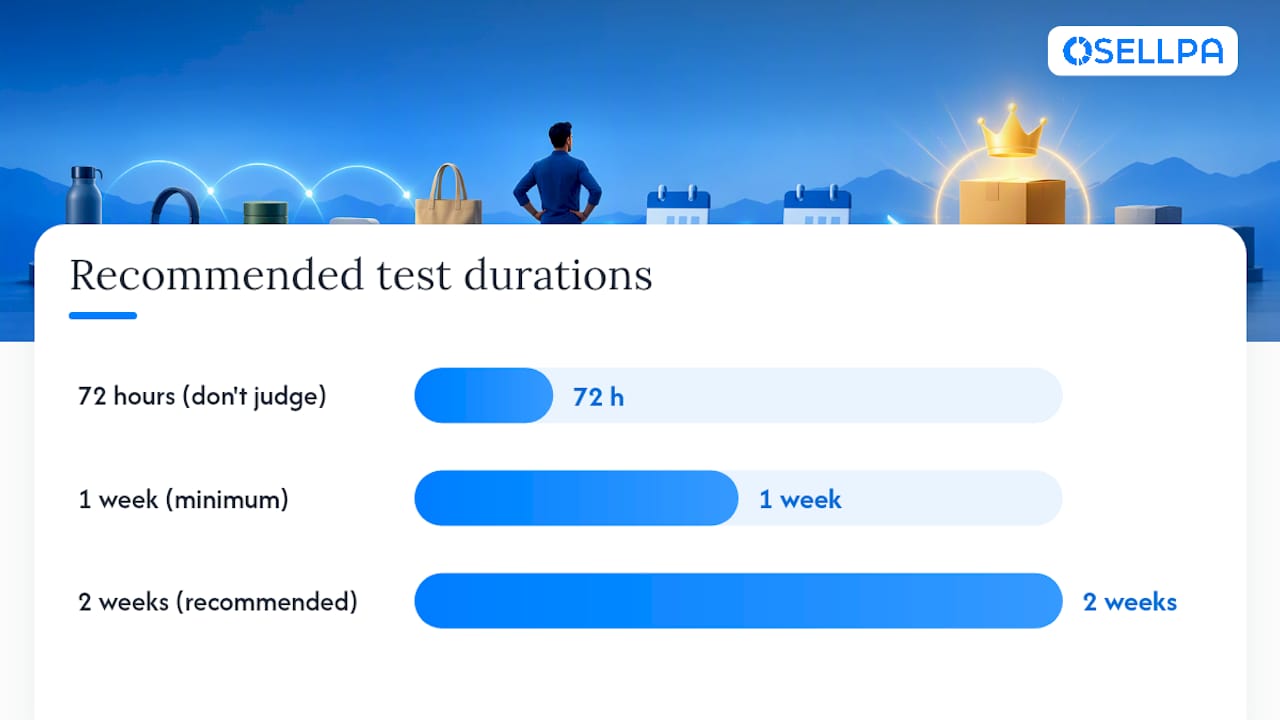
- Let phrase run long enough to mean something. Amazon’s own targeting guide suggests testing new keywords for at least one to two weeks before judging or pausing them, long enough to clear a reasonable sample of impressions and clicks.
- Set a promotion threshold before you start, not after. Decide in advance what counts as a winner, commonly two or more orders at an acceptable cost, or a conversion rate that beats your account average.
- Pull the winning search terms and add them as exact keywords. Add the original phrase-match term as a negative exact inside the phrase campaign so the new exact keyword takes over that query.
- Repeat weekly. Discovery never really stops; new search terms surface every time Amazon’s algorithm reshuffles auction eligibility.
Pro Tip: Don’t judge a keyword on day three. A search term with two clicks and no sales after 72 hours tells you almost nothing, run the full test window before deciding.
Manual review of search-term reports works, but it’s slow, and most sellers only get to it once a month if that. Rule-based automation platforms can flag qualifying search terms and promote them to exact the moment they cross your threshold, rather than waiting for the next spreadsheet session.
How should you set bids across match types?
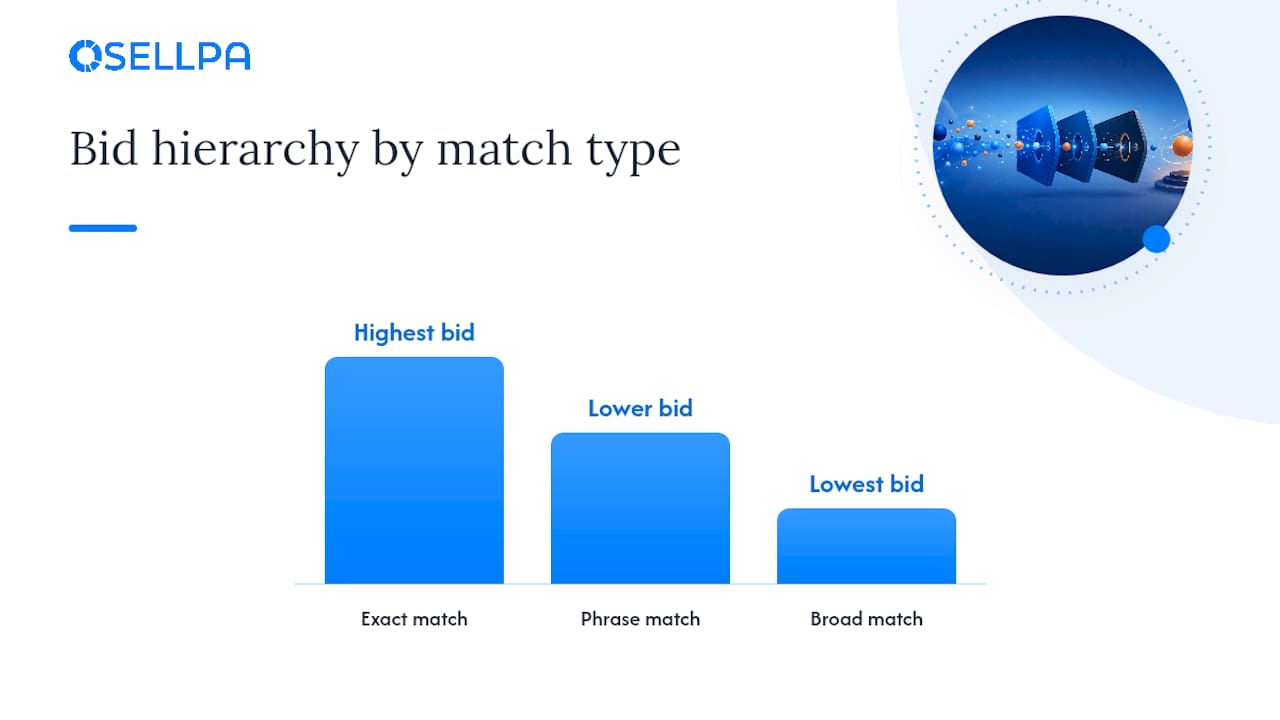
Bid hierarchy matters as much as match type selection. Amazon’s targeting guide recommends setting the highest bids on exact match, lower on phrase, and lowest on broad if you run all three. The logic holds up: exact match keywords are your proven performers, so they deserve the budget priority. Phrase match is still earning its keep.
Treat Amazon’s suggested bids as a starting figure, not a target. They reflect competitive auction data, not your margin, so adjust them against your own profit contribution once you have real sales data.
Negative keywords are what stop your own campaigns competing against each other:
- Add the search term that triggered a phrase-match promotion as a negative exact inside the phrase campaign.
- Add irrelevant or low-margin variants as negative phrase or negative exact wherever they surface, regardless of which campaign found them.
- Check placement reports separately. A keyword performing well on the top of search can look mediocre blended with product-page placements.
Pro Tip: Review your negative keyword list monthly, not just when you promote a winner. Old negatives can block legitimate new demand once your catalogue or pricing shifts. A structured negative keyword strategy keeps phrase and exact campaigns from cannibalizing each other’s budget.
What metrics actually show which match type is working?
ACOS alone hides the story here. Amazon’s own measurement guidance warns against judging match types by ACOS in isolation, recommending spend, impressions, clicks, conversion rate, CPC, and profit contribution together.
Phrase and exact play different roles in the funnel, so measure them differently:
- For phrase (discovery): track impressions and the number of distinct search terms generated. A phrase campaign with rising impressions but flat conversions is still doing its job, surfacing queries you can qualify.
- For exact (harvest): track orders, ROAS, and CPC stability. Exact should show tighter variance week to week once it’s running proven terms.
- For both: fold advertising spend into net profit calculations that include COGS, FBA fees, and shipping, not raw revenue.
A useful benchmark: if your exact match ACOS looks worse than phrase on the same keyword, check the search-term report before assuming exact underperforms. It’s often absorbing higher-intent, higher-CPC traffic that phrase never sees.
Common mistakes sellers make with phrase and exact match
Three mistakes account for most of the wasted spend Osellpa sees in seller PPC accounts.
- Assuming exact means one literal query. It doesn’t. Plurals and close variants still qualify, so audit your search-term report rather than assuming your exact keyword controls exactly one search.
- Running the same keyword in phrase and exact without negatives. Both campaigns become eligible for the same auction, splitting data and often bidding against each other.
- Comparing ACOS across a discovery campaign and a harvest campaign. They’re measuring different jobs. Compare conversion rate and search-term yield for phrase; compare ROAS and CPC stability for exact.
What running these campaigns week to week actually looks like
A weekly search-term review catches promotable keywords before competitors do; leave it a month and you’ve likely paid for demand you never converted into exact, tightly bid targeting. The pattern holds across most accounts: phrase match surfaces the query, a short test window proves it, and exact match locks in the economics.
Automation changes the maths here more than most sellers expect. Osellpa’s rule-based promotion checks search-term reports against your thresholds automatically, so winning terms move to exact without waiting for a spreadsheet session, and budgets don’t leak into queries that already proved unprofitable. Osellpa reports that sellers using its PPC tools see up to a 20% increase in sales, a brand-reported figure rather than a guaranteed outcome, but it tracks with what disciplined match-type management should deliver once the manual lag is removed.
— Harry
Get Osellpa to run the phrase to exact workflow for you
Osellpa automates exactly the workflow this guide describes: it tracks search-term performance against your profitability thresholds and promotes winning phrase-match terms to exact campaigns without you touching a spreadsheet, all through direct integration with Amazon’s advertising API. That’s the practical advantage over running this manually, the promotion happens on schedule, not whenever you next find an hour to review reports.
If you want to see where your current campaigns are leaking spend between phrase and exact, start with a look at Osellpa’s PPC bid optimisation reports or check the pricing plans, which start at £10 a month on the Launch plan. Some users have reported sales increases after implementing such automations, though outcomes may vary and should be evaluated individually.
Sources
For the primary rules on how match types behave, read Amazon’s own help pages on phrase and exact match and its guidance on campaign structure and keyword targeting. Search Engine Land’s breakdown covers auction overlap in more depth. For search intent fundamentals behind keyword selection, see this explainer on Amazon SEO.
FAQ
Is exact match always cheaper than phrase match on Amazon?
Not necessarily. Exact match often converts better because it targets proven search terms, but Amazon’s own guidance treats this as a tendency, not a guarantee, since competitive bidding on exact keywords can push CPCs higher too.
Does exact match on Amazon really mean an exact query match?
No. Amazon’s exact match includes plurals and close variants, so “backpack” as an exact keyword can still trigger on “backpacks” or minor word-order variants Amazon judges equivalent.
How long should I test a phrase match keyword before promoting it?
Amazon recommends testing for at least one to two weeks to gather enough clicks and orders before deciding whether to promote a search term to exact or pause it.
Can Osellpa automate moving keywords from phrase to exact?
Yes. Osellpa’s PPC tools track search-term performance against profitability rules and can promote qualifying terms from phrase to exact automatically, removing the manual weekly report review most sellers rely on.
Should I ever run broad match alongside phrase and exact?
Broad match can widen discovery further, but it needs the lowest bid tier of the three and close negative-keyword management, since it’s the least precise of Amazon’s three match type controls.